Friday, July 27, 2007
Pictures: Week One
Pictures: Opening Camp (7/19/07)
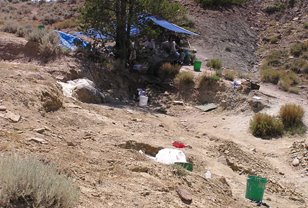
First things first...setting up camp. This is from the ridge just above the quarry looking back at camp...a 1/4 mile hike or so.
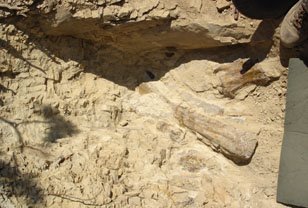
Erosion can be a paleontologist's best friend or worst enemy. Each flag in this photo represents an exposed fossil unearthed by large rain storms since last summer.
Here are Mackenzie and Angela escaping the sun while still doing some work. Dr. Glenn Storrs (boots in the foreground) is not sleeping, just getting a better angle... :)
Wednesday, July 25, 2007
July 22-25, 2007
Sunday, July 22
Everyone arrived safely in Montana today, despite some airline issues. We're joined this week by Sally, Emily, Susan, Ian and Lynette, hailing from Virginia, Colorado and Connecticut, respectively. Bob, another volunteer from Cincinnati Museum Center also jined us at the YBRA. Sam and Angela joined me on the first trip into Billings while Mackenzie and Sara joined Glenn on the first prospecting trip of the year. The Mother's Day Site is fantastic, but many of the staff and volunteers are getting antsy for something new. Sara proved (once again) to be an ace in the field by discovering a beautiful lungfish tooth, while the trio also discovered an ankylosaur vertebrae and a scute from a turtle shell, all from the early Cretaceous (as early as 146 million years ago). Prospecting will continue during our stay here in Montana, and we hope to find some really promising locations.
Monday, July 23
Today's Mother's Day Site (MDS) temperature: 115 degrees
Today was "Introducion to Local Geology" Day. While it may sound less exciting than your typical vacation, our group was given a tour of more than 4 billion years of the Earth's history in about 6 hours.
The day started with an overview of the three major principles in evidence here in the area and which really allow us to understand how to read the rocks around us and the story they can tell us. While I won't go into great detail here, the three principles are: Original Horizontality, which states that most layers of sedimentary rocks are deposited in a horizontal position; Superposition, which states that as rocks are layered one on top of another, the layers on top are newer than the rocks on bottom...and vice versa, the rocks on bottom are older than those on top. This can be subverted, however, by the third concept, the Principle of Cross-Cutting Relationships. This principle states that igneous rocks that intrude into sedimentary rocks (e.g., magma) is always younger than the sedimentary rocks into which it intrudes.
These became clear to everyone as we traveled up the nearly 5,000 foot climb to the Beartooth Plateau via the Beartooth Highway (named by Charles Kuralt as America's Most Scenic Highway). After some breathtaking scenery (and altitudes), we headed bck down into Red Lodge for a little local history lesson including the adventures of "Liver Eating" Johnson and The Sundance Kid, both popular figures in the history of this 123 year old town.
Next it was on to Bearcreek and the site of the Smith Mine Disaster of 1943. Coal mining had been a booming business in the Bear Creek valley since before the turn-of-the-century, and had been waning in the days before World War II began, but the death of 74 miners in 1943 effectively ended the industry in the valley. I'll post more about Bearcreek and the Smith Mine later.
Our next stop was at the mouth of the Clark's Fork Canyon near Clark, Wyoming. This magnificent bent rock formation is one of the finest examples of the shear force exerted as the Beartooth Mountains were thrust up and to the east some 55 million years ago.
Finally, we made it to the Mother's Day Site around 3:00 or so, ust in time to get a quick overview of the site and where our guests would be digging on Tuesday.
Tuesday, July 24
Today's MDS temperature: 110 degrees
First full day in the quarry. Still more of an orientation as everyone is getting used to their tools and how to identify fossilized bone from the rock that surrounds it, including the funny but effective touching of the fossils to your tongue -- a true dinosaur fossil will stick.
Red Lodge and the YBRA received a fair amount of rain today, lowering the local fire warnings from VERY HIGH to a more modest HIGH. The MDS site received no rain but once again had its share of windstorms, one at about 6 a.m. and another that hit at about 6 p.m.
I decided to rough it and stay at the camp site rather than the YBRA. Glenn calls it banishment (tongue in cheek), but I really do enjoy being out there...even if I have to wear sunglasses until 10 p.m. in order to keep the dust out of my eyes. As a peace offering to Sam, Mackenzie, Sara and Angela, I bought the ingredients and made Pasta Alfredo (with chicken for our non vegetarian staff) and fresh green beans with garlic. It seemed to go over pretty well. We were also joined by Cathy Lash, the graduate student from the University of Montana working at the nearby Depression Reservoir site.
Wednesday, July 25
Today's MDS Temperature: 96 degrees
First, a much cooler day. Clouds and a few light sprinkles held temperatures at the Mothers Day Site in the 80's or so for much of the morning before climbing into the mid 90's by day's end. Emily and Sally have been excavating a vertebrae and will probably be ready to to jacket the piece by around lunchtime tomorrow. I'll go through a step-by-step preparation for these protective outer casings placed on fossils at a later time, but everyone should be elbow-deep in plaster by the end of the week. Susan and Ian have encountered what we lovingly refer to as the "Mother's Day Curse" where just as you think you've found the end of a bone, you realize that there is another bone blocking you from getting it out of the ground. For those of you who have ever played "pick-up sticks", the fossils at MDS are a lot like that. Lynette has been assisting Sara, Mackenzie and Angela on a large block of fossils which has been producing some really nice things. Unfortunately, it's really slow going. Bob has been working on some pretty tricky vertebrae pieces intermingled with some rib fragments, but is making much progress.
Sara continues to be the star of the show, however, unearthing a potential gastrolith (stomach stone) which is larger than any other discovered in the site. Today, however, she discovered a fibula which is in an EXCELLENT state of preservation. Mackenzie has also top-jacketed a large rib which is also in wonderful condition. Sam is working under the main tent with Susan and Ian and also has several nice bones working. I have several cervical vertebrae on which I'm working. These bones are extremely complex and have been slightly weathered, but I'm confident they'll come out by the end of the week...maybe. Angela, who has had much experience at another dig in Utah, has been working with Sara and Mackenzie to learn specific processes as they relate to this site (which is MUCH different than the Utah site), and her MP3 playlist is keeping everyone upbeat despite the heat. We were also joined by an old friend, Dale Gnidovec from the Orton Museum of Geology at Ohio State University. He and Glenn's relationship goes back to graduate school, and he is a very welcome addition to the crew. He'll primarily be prospecting in some of the new areas with Mackenzie (and perhaps Sam) accompanying him most days.
This evening was laundry night at the camp site. haven't heard yet if they were able to get to the Bridger Cafe for milkshakes, but I'm hoping they did. Back at the YBRA, our guests were treated to a lecture by Glenn on the history and working hypothesis of the site and how it was formed some 150 million years ago.
Monday, July 23, 2007
Setting up camp...and surviving the heat
We departed Murdo, SD pretty early in the morning and made our way toward The Mammoth Site in Hot Springs, as mentioned in the previous post. Glenn headed straight to Hot Springs while Sara, Angela, Mac, Sam and I headed to Mt. Rushmore for some quick photos and then onto Hot Springs. We met up with Don Esker and explored the facility which was truly amazing. We also got a local take on the "Alabaugh Fire" that killed a resident south of Hot Springs and forced the evacuation of hundreds of others. We're hoping to maybe make a retunr visit on the way back through South Dakota, but that remains to be seen.
After departing Hot Springs, we all headed into Wyoming, with a quick detour to Devil's Tower, and then another 5 hours or so to the Mother's Day Site in Montana (except for Glenn who had wisely stopped in Sheridan, Wyoming). We arrived at the base of the access road just after midnight and walked the quarter mile upo to the camp site, checking for potential erosion to the drive which might prevent the van, truck and trailer from making it up safely. Unfortunately, we found that a great deal of the glorified cowpath had washed out, and none of us felt like wielding a pickaxe or shovel at 1:00 in the morning. So, back into Bridger and a nice comfortable motel bed...nope! The Bridger Motel offices close at 9:00, so we headed to a rest area on the edge of town for a few hours of sleep...or at least an attempt at it.
Thursday, July 19
6:30 a.m. and we were all awake...well, almost...and we stopped for breakfast at the Bridger Cafe & Casino. The casino part is really just a few video poker machines which seem to be more plentiful in Montana than prarie dogs. A good breakfast in our bellies and it was back to the dig site for some manual labor. By the time we finished road repairs at around 10:00 or so temperatures were already in the mid 90's and we started setting up tents and re-hydrating ourselves.
Glenn arrived as we were heading out for lunch (again at the Bridger Cafe), so we unhooked the trailer and headed into town. Just as a note to you travellers out there who may find yourselves in Bridger one day, all of us would HIGHLY recommend the hand-dipped milkshakes...though the staff will grumble quite a bit if you attempt to order 6 of them like we did. While in town, we also stopped for groceries...and began to learn about how to make a vegetarian-friendly menu. For some reason, SPAM and Pork&Beans don't fit in that menu, but I think we're making it work...or at least trying to.
We also did a pretty thorough inspection of the Site which the BLM had informed us had been looted after our departure in 2006. While we found no evidence of looting or what might be mising, we did find that the Montana weather had done a great deal of the work for us with some EXCELLENT bones being partially exposed but without the weathering damage one might expect. We were also joined briefly by Cathy Lash from the University of Montana who is working a nearby site with some early marine reptiles.
Right at sunset, I became the first of the group to find a rattlesnake. I'm not sure who was more startled by the encounter, but I'm willing to bet it wasn't the snake. This 3' olive-colored rattler had come right into camp, something which locals have told us is more and more common this year. Plentiful rain in the Spring, and the resulting vegetaion, caused a population boom in both predators and prey, so the snakes have become a bit more agressive. Worse than the snake, though, was the wind/dust storm that kicked up shortly afterwards. Lasting more than five hours, the storm victimized Angela's tent and filled the rest of ours with an annoying amount of dust and sand. Angela's tent is salvageable but if anyone would like to buy her a new one, I don't think she would be opposed.
Friday, July 20
How many 1/2 mile hikes does it take to setup a dinosaur dig? Too many. Before temperatures got too hot (it eventually reached more than 110-degrees), we began the process of carrying plaster (200 pounds to start), water (about 20 gallons), and various tools and other necessities up to the dig site from our camp. By the time lunch rolled around we were all spent, not having full acclimated to the altitude and heat. So, we hopped in the air-conditioned van to do a follow-up inspection of the Dodson Site down near the Wyoming border. This is the site where we removed a fully articulated Diplodocus (the final piece weighing about 3,500 pounds). We took a look for any pieces which may have washed out or been exposed over the winter, and fortunately, found none. Mac and Sara then took us to look for some petrified wood which had also been found nearby.
After some final, emotional farewells to the Dodson Site, we headed to a nearby location well-known for its well-preserved fossil fishes. Sara and Glenn each found a fossils which included soft tissue (very impressive) while the rest of us came up empty-handed. We headed back into Bridger for water and a few more food items and then settled in for the night.
Saturday, July 21 (aka, Harry Potter Day)
Predicted temperatures in the 115-degree range make us rethink our plans, especially since the dig site was a fairly easy one to open this year. We spent a few hours helping Sam build an adjustable tent of tarps which could cover the dig and protect all of us from the sun. A few rope burns later, we had what amounts to a pretty nice structure. I'll post pictures later...it's quite impressive.
We headed over to Red Lodge in anticipation of our first showers in several days and stopped to pick up a couple of copies of the final Harry Potter book which we had pre-ordered from somewhere on the road in South Dakota. Red Lodge is a small town at heart, but sometimes they do things in a very big way. After having gone to the YBRA to take showers, we all headed into town to enjoy the Iron Horse Rodeo, a motorcycle rally that literally takes over the town for 3 days in late July, shortly before the Sturgis Rally in South Dakota. There had to have been a thousand bikes lining the usually serene streets and the diversity of riders was quite amazing.
We left Red Lodge hoping to catch the Jim Bridger Days in Bridger, MT but got back a little too late, though Glenn made it in time to run into Cathy Lash (from a few paragraphs up) who explained that the demolition derby was quite an event.
Our participants for Week One will be arriving on Sunday, July 22. I'll post more about them and their first day in Montana in the next day or so......To Be Continued
Wednesday, July 18, 2007
July 17, 2007 -- Part Two
It is probably going to be a few days until I can post again as tomorrow evening will see us in the desert settling in and and setting up camp. Please feel free to post your comments...it makes this a lot more fun for me, certainly. See you then!
Tuesday, July 17, 2007
July 17, 2007
In addition to Sam, Sara and Mackenzie, we were joined by Angela yesterday morning. These 4 students (well, Angela has just finished her undergrad program and is heading to grad school later this summer) are going to prove very important to the ongoing success of the Dinosaur Field School and the Mother's Day Site. They are all extremely experienced and knowledgeable, and their personalities are making for a good time in the van (which I'm driving). But probably the funniest "crisis" was when a couple of them realized they hadn't made arrangements to have the new Harry Potter book shipped to them in the field. Crisis averted--we called ahead to the good folks at Red Lodge Books to pre-order the book and will be able to pick it up on Saturday.
As we're heading west, we're also trying to keep an eye on the weather. It's predicted to be 101 in Rapid City, South Dakota today (we'll probably reach there late this afternoon or evening) and Billings, MT will be hovering around 100-degrees for at least the next several days. The best part is that the dig site averages about 10-degrees hotter than Billings, so I'll let you do the math.
Well, it's about time to get back on the road, so I'll post again later. Ciao!
Sunday, July 15, 2007
July 15, 2007
We managed to get everything loaded in a little less than three hours and then went our separate ways for one last evening with family and friends. We'll be leaving Cincinnati at around 10 a.m. on Monday morning, aiming for Iowa City or possibly Des Moines on our first day of driving. I will be posting a long the way as possible.
Keep checking back!
Tuesday, July 10, 2007
Protecting Fossils: Paleontological Resources Preservation Act
So begins the proposed Paleontological Resources Preservation Act, currently before the US House of Representatives as H.R. 554 and the US Senate as S.320.
I am writing this post as a professional paleontologist with an active interest in the rights and responsibilities of amateur paleontologists, I'm writing to say that this is finally the bill that addresses all of our needs and the one that we can, and must, all support. I'll say it up front:
Everything that can be done legally on federal land today, will be allowable after the passage of this bill!
That's it in a nutshell. No one should be afraid of this legislation unless they plan to steal the natural heritage of the people of the United States. There is much mis-information out there, but the Act would not affect private land. It does not affect private collections. It does not restrict individual rights or freedoms. It reaffirms that rare and scientifically significant paleontological resources in the public domain should remain the property of all Americans and thus be available for our children and for future generations. Only the illegal exploitation of public property is proscribed. Period.
What does this bill do for the amateur community? Plenty. It encourages the participation of amateurs in the stewardship of fossil treasures. It reaffirms their right, and maximizes their opportunity, to collect rocks, minerals, and common fossil invertebrates and plants on public lands where they may do so today. It lays out a uniform policy that lets all collectors know just where they stand in regard to the law, rather than their being faced with a multitude of complex and confusing policies from each federal land management agency. It also fosters paleontological education at all levels. We can all be happy with these provisions.
What does it do to protect rare fossils? It ensures that they be collected under permit by responsible parties, both amateur and professional, and be reposited in public collections, just as is required today. It mandates that federal managers use appropriate care to inventory and monitor these resources for scientific and educational use. It requires them to increase public awareness of our fossil heritage. Just as archaeologists are consulted for archaeological resources, so now paleontologists, professional and amateur alike, will be consulted for the management of public fossil resources. Partnerships with the general public are to be encouraged. Again, these are all good things for everyone.
Why is this bill needed? Firstly, to achieve all of the aims listed above. Secondly, because the theft of our country's public fossil heritage is growing and nonrenewable public resources are increasingly at risk. We all know stories of fossils commanding ever higher prices on the commercial market. Sadly, this is also driving a growing black market. Fossils on public lands belong to you and me. We can not allow them to be lost to us through theft, and increasingly, stories about high prices for fossils include stories of their theft from public lands.
Let me emphasize that this is not a bill to outlaw the sale of fossils. There is a legitimate place for commercial collecting and for the sale, barter, trade, and private ownership of fossils. Equally, there are stories of the great scientific and educational role that amateur and commercial collectors have played, and continue to play, for the good of paleontology. I applaud this role and expect that it will continue. This bill encourages partnership between all sectors of the community. The collecting and sale of fossils from private land is not effected.
However, the bill does ensure that fossils in the public domain, those that now belong to you and me, and to our children and future generations, will continue to belong to everyone. I greatly feel this need. Responsible dealers and collectors, i.e. the majority of paleontology "enthusiasts", for I prefer the original French meaning of "amateur" - one with a passion or love for a subject, feel the same way.
Fossils are non-renewable - they can't be grown like forests. Fossils have scientific and educational value - there is intellectual content inherent in them that cannot be mined for profit as one might do with oil and other mineral resources. Public paleontology resources require responsible stewardship and long-term preservation. They need protection from theft and exploitation. Fossil enthusiasts of all levels of experience must have their rights protected and enthusiasm encouraged. The "Paleontological Resources Preservation Act" does just that.
I hope that I've been able to inform you, and calm any fears that you may have, about this long overdue effort in Congress. The report from the Society of Vertebrate Paleontologists, including a full-text version of the bill, is available on-line at:
http://www.vertpaleo.org/society/PRPAct.cfm
Please take the time to read it. There are no hidden issues here. It's available for all to examine. Public fossil resources are in need of protection for the continued benefit of all and this bill ensures that they will have it.
Friday, July 06, 2007
Dr. Glenn Storrs to Speak at Beartooth Nature Center -- July 29, 2007
Our very own Dr. Glenn Storrs, Assistant Vice President for Natural History & Science and Withrow Farny Curator of Vertebrate Paleontology will be speaking at the Beartooth Nature Center in Red Lodge, Montana on July 29.His talk will include a discussion of Cincinnati Museum Center's current work in the area around Red Lodge and why the geology and paleontological resources in the area draw so many students and researchers.
The event is FREE, and refreshments will be served. For more information, call 406-446-1133.
Monday, July 02, 2007
Paleontology: The Gateway Science
My experience in working with students in this age range (6-10 years old) is that they are sponges when it comes to understanding how these fossils were left behind and how we, as scientists, know so much about these animals that may have been extinct for 65 million years or longer. What does a typical student response to the bird-dinosaur connection sound like? "Well, duh, everyone knows that!"
In order to completely understand (or teach) the earth and life sciences in the here and now, does it not help us to understand the foundations and history of the earth and the life upon it? We don't need to expose first and second grade students to a graduate level seminar on the Law of Superposition, but by encouraging these very same students to look at a road cut and examine how fossils change from bottom to top, we are exposing them to the basic fundamentals of ALL science--inquiry.
This is our in-road, as scientists and as educators, to bring students into the fold at an early age. By building on this fascination with dinosaurs at age 6 or 7 (instead of waiting for the dinosaur fever to die at age 11 or 12), we can engage youth with real, hands-on science that will provide an authentic application of the scientific method. With this foundation in place, the introduction of the physical sciences, biological sciences, and other earth sciences will be a much easier transition.
So, how does this tie-in to the Dinosaur Field School? Following this year's field season, we will begin preparations for a teachers-only seminar including field experiences in the Cincinnati area and in Montana for Summer 2008. Pending a little funding to help us get started, we should have more information in November or December. Check back often for updates!
Thursday, June 21, 2007
Responsible and Ethical Fossil Collection - The Bureau of Land Management
Many paleontologists (both amateur and professional) choose to look for fossils on privately-owned property, but the process for working on BLM-managed property is a very rigorous one. Some plant and invertebrate fossils may be collected by amateur paleontologists on federal land, but to prospect or collect vertebrate fossils (including trace fossils like trackways, coprolites, or skin impressions) requires special permits.
"Fossils found on public lands are important for the story they can tell us about the development of life on Earth and about the physical changes in the Earth itself. They provide clues to a myriad of important and intriguing questions, from the “hot” topic of dinosaur extinctions to studies of plate tectonics (the geology of the Earth’s structural deformation). Consequently, the public lands provide great outdoor laboratories and classrooms for the study of paleontology and also contribute significantly to public exhibits found in museums. For example, BLM’s Cleveland-Lloyd Dinosaur Quarry in Utah has produced fossils that are exhibited in over 40 museums worldwide. Undamaged, BLM’s fossil resources can reveal not only how the plant and animal communities have changed, but how the face of the Earth has been altered by the movement of continents, the uplift of mountain ranges, the appearance and disappearance of ice caps, and the flooding and drying of huge areas of land.You can find out more about the BLM and the many projects they manage by visiting their website at http://www.blm.gov, or by reading their America's Priceless Heritage: Cultural and Fossil Resources on Public Lands (2003), from which the quote above is taken.
The need to protect these precious resources is urgent—BLM does not have the luxury of leaving the preservation or restoration of a unique cultural or paleontological resource for another day. As the agency pursues its multiple use mission, we need the help of the public to do so in a manner that meets contemporary economic and community goals, while conserving our priceless heritage for the next generation."
Tuesday, June 12, 2007
Mother's Day Site...revisited
Well, we're gearing up for our return trip to Montana. With less than five weeks until our departure from Cincinnati (egads!), our gear and tools are being counted and checked for damage, vehicles are being procured (and given a thorough tune-up), and we're trying to conclude the more administrative responsibilities we have here before saddling-up for the 26-hour cross-country drive.Early in preparations for the 2006 season of the Dinosaur Field School, Dr. Glenn Storrs explained the history of the quarry where our dinosaurs are being unearthed every summer. I wanted to share that once again so those of you who are joining us for the first time can have a little bit of background.
The Mother's Day Site, in south-central Montana, was discovered (on Mothers' Day, natch!) in 1996 by Kurt Padilla, a volunteer for the Museum of the Rockies in Bozeman, Montana. The site was worked for two years for MOR by Kristy Curry-Rogers (now at the Science Museum of Minnesota). With other projects in the Cretaceous taking priority, MOR was unable to continue its excavations at Mother's Day and with their blessing (thanks again, Jack!), staff at the Bureau of Land Management (BLM) asked me to take on the excavations at the site in order to preserve its fossils for the benefit of the American people and the scientific community in general. As with all vertebrate fossil sites on federal land, we work under permit to the BLM and all collected specimens are reposited at Cincinnati Museum Center where they can be accessed by all.
The site preserves thousands of bones of dozens of, mostly young, sauropod dinosaurs. We believe that a single herd of gracile diplodocids, probably Diplodocus, became trapped at a shrinking water hole during seasonal drought about 140 million years ago. The site is thus a monospecific, catastrophic assemblage that provides insight into Late Jurassic environments and paleoecology, and on the paleobiology of a single species of giant dinosaur. Of course, the seven years of work up to this point have given us a better understanding of the site than when we began our excavations. A master's degree under my supervision at the University of Cincinnati by T. Scott Myers (now at Southern Methodist University) has been completed recently on the taphonomy (environmental and depositional history) of MDS and has answered many of our initial questions. Scott and I are undertaking to publish this work now.
Saturday, June 09, 2007
Dinosaur Field School Featured on Dinosaurnews.org
Wednesday, June 06, 2007
Blogging about Digging Dinosaurs
When we started the Dinosaur Field School Blog last summer, we had no real goals or targets about who would visit or where they might come from. As the hits kept coming, we were surprised to see where our visitors were coming from. In the 10 months or so since we went live, we’ve seen visitors from 21 foreign countries and 44 states (plus the What this has proven to me, and to others at Cincinnati Museum Center, is that even in this age of media and on-demand gratification, the simple story of scientists and their love for their work (in this case, paleontology) is still a powerful one.
This DFS Blog is coming back to life as we approach the start of the 2007 field season, officially beginning in mid July when a group of us will be traveling by caravan to
Tuesday, May 22, 2007
Bone-By-Bone: Assembling A Dinosaur Skeleton
Now on Exhibit, March 31 through July 8, 2007
Cincinnati has never had a real dinosaur skeleton of its own—until now!
Cincinnati Museum Center paleontologists are preparing a skeleton of the carnivorous dinosaur Allosaurus fragilis for future exhibition in the Museum of Natural History & Science. Beginning March 31, visitors can see staff members and volunteers assembling the bones of this 25-foot long theropod, or bird-like dinosaur, in the John A. Ruthven Exhibition Gallery. Allosaurus was a major predator in North America 140-million years ago during the Jurassic Period. Museum Center’s specimen comes from the famous Cleveland-Lloyd Dinosaur Quarry of Emery County, Utah.
Visitors have the unique opportunity of being able to witness the assembly process up-close as the skeleton goes together bone-by-bone. The methods and materials by which dinosaur skeletons are preserved and exhibited are also on display, and visitors have the opportunity to discuss the project first-hand with staff as the skeleton comes together. Visit again and again to see the project progress!
Admission to this exhibit is free!
See an interview with Glenn Storrs about the project, part of the CETConnect.org website.
View a live webcam of the exhibit at CETConnect.org
2007 Dinosaur Field School Information
2007 Session dates:
Week 1: July 22 through 28
Week 2: July 29 through August 5
Cost:
Museum members: $1,150
Non-members: $1,250
Fees includes all instruction, collecting tool rental, lodging, meals and transportation to and from camp once in Red Lodge. Transportation to Billings, Montana, from your home and back is not included. Lodging is dormitory-style, with a men’s and a woman’s cabin. Private cabins may also be available by early registration.
Registration:
Space is limited, so please register as early as possible. A full registration packet and medical release form will be mailed upon request. A $600 per person non-refundable deposit is required, together with the registration form and signed waivers to secure your reservation.
Payment Schedule:
The remainder of your balance is due by June 12. Refunds of the remaining balance, minus the $600 deposit, will be made until June 26. After June 26, no refunds will be made. There can be no refunds for unused options of the planned itinerary.
Instructions:
Plan to fly to Billings or drive to Red Lodge. You should arrive in Red Lodge by 5 p.m. on day one of your session. If you need transportation from Billings, you will be picked up at the airport. If you are driving, directions to YBRA can be downloaded. In either case, be sure to apprise us of your travel details. Plan to depart in the afternoon of day seven. You will need to bring your own sleeping bag and personal items—see recommended field gear list.
Questions:
Please do not hesitate to call the Museum's Information and Reservation office at (513) 287-7021 or 1-800-733-2077 x7021.
Tuesday, November 14, 2006
November 14, 2006
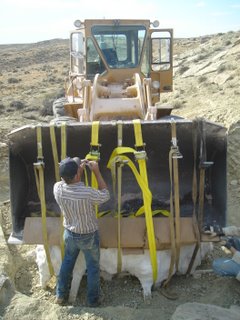
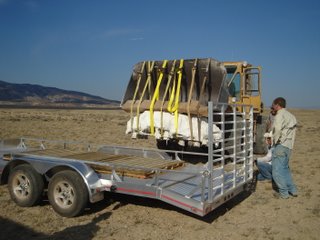
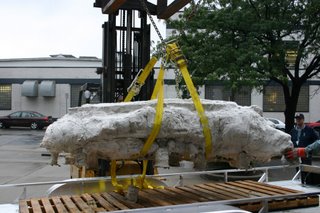
3,500-lb Dodson block is attached to the front-end loader.Dodson block is moved approximately 3oo meters, uphill.
Carefully moving the block into place.
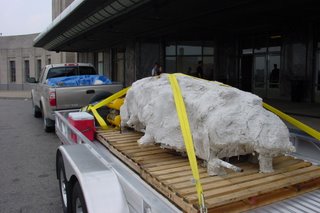
1,623 miles later at Union Terminal.
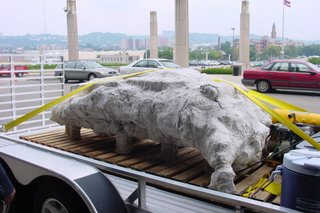
The block on its protective support pedestals of 4x4 lumber.
Offloading at Geier Research and Collections Center.
Temporary resting place in Paleontology storage facility.
Monday, November 13, 2006
November 13, 2006
Following a productive dig season this summer, we're busily working on a number of projects whose details will be forthcoming on this blog, including the Allosaurus project which Dr. Storrs had mentioned in an earlier post. Beginning in the Spring, you'll be able to join us at Union Terminal as we assemble Cincinnati's first complete dinosaur skeleton in full-view of the public. We're also working on ways in which our visitors from around the world can watch live via streaming video.
There's always something exciting happening at Cincinnati Museum Center, and we hope you keep visiting us to learn more.
Until next time...
Wednesday, August 16, 2006
August 16, 2006
What happened on Monday? Clockwork. Although it was a long, hard, worrying day, everything went fine. I picked up the trailer, made the necessary adjustments and changes, found some discarded pallets, cleaned up the “Dodson” Site with Sara, Sam and Mac, got new license plates for the (still sort of) new truck, and waited for the loader to arrive – which it did. Some large nylon tie-down straps and an hour or so of care later and the Diplodocus dorsal series was secure on the trailer. Thanks, all! We really appreciate your help. A visit to some truck scales showed that our minimum estimate was dead-on – 3500 lbs. What a relief to know certainly that we have not exceeded our gross weight limits. Still, pulling a trailer takes some care, so I’ll ease it on down the highway, probably arriving at the Museum on Friday.
The rest of the gang are closing up Mother’s Day in the next few days – finishing up collecting, covering for the winter to protect against exposure and vandalism (we’ve never had any problems), and then – heading to Utah! Don spent a week at his thesis site near Castledale and returned with news that he had found some good material but hadn’t time to collect it. So – everyone jumped to his aid with offers to help him complete his M.S. research and I gave them my blessing to go. They will probably have a week of work before the season ends and all are back in Cincy. Make hay while the sun shines (or the roads are not muddy) as they say. An extra week for the gang will be good experience for all, help out Don, salvage some significant fossils for the benefit of all, and adds little to the total cost of the summer field work (they are camping – and dieting! – after all). I expect that Mason will be able to continue the blog at some point to let you (and me) know how things have gone.
As for me, I’m signing off (for now). Look for an update or two to follow about how arrival at the Museum went and where one might see these fossils now (our exhibit prep lab, I hope). Indeed, we may continue this blog on occasion with info about preparation of the fossils. I also have a great Allosaurus project you may like to hear about. Until then, all the best, come and visit. and keep on supporting those museums!
Cheers, G-
Monday, August 14, 2006
Dinosaur finds!
Field-schooler Bob Bergstein enjoys time with his find.
Diplodocus block at the “Dodson Site” shows signs of real progress.
Sara’s block is nearly ready to go!
Example of in place chert pebble at the Mother’s Day site suggests our dinosaurs carried stomach stones (gastroliths).
Newly exposed radius (forearm) awaits collection.
Juvenile scapula (shoulder blade) lies among ribs at the Mother’s Day site.
Stegosaurus comes to call on Diplodocus caudal vertebra (tail bone)!
The land, the crew and the moose
Textbook example of sandstone cross-bedding shows evidence of ancient river currents in rocks of Petroglyph Canyon.
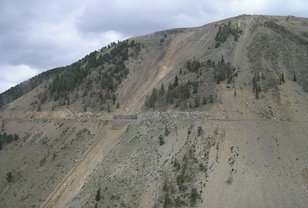
The Beartooth Highway is again open after last year’s catastrophic landslides.
Crew members seek refuge from the sun at Mother’s Day Quarry.
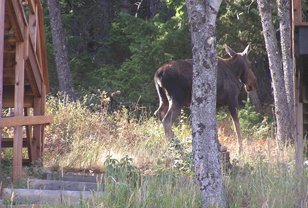
Mama moose (Cowwinkle?) pays a visit to Glenn’s cabin. Saturday, August 12, 2006
August 12, 2006
First, my promise to type about the Yellowstone-Bighorn Research Association – then an update.
The YBRA is a fantastic place. Perched on the flank of Mount Maurice, overlooking Red Lodge and the start of the Beartooth Highway (Charles Kurault’s “most beautiful highway in America”), it has been home to countless geologists and students for 70 years. Begun by Princeton and a consortium of other schools, including the University of Cincinnati, geology majors have repeatedly been plunked here in the midst of spectacular scenery (both aesthetic and geologic) for exposure to basic field geology and techniques. Many YBRA students have gone on to become geologists themselves, frequently professors returning to camp to teach the next generation. Thus, a strong sentimental regard exists for the place among generations of geologists (I myself first came here as a graduate student in 1983).
It has long been my desire to prevent my crew and dino school participants from learning much about the faculty cabin that I have worked my way up to over the years. Starting in a student dorm where these folks now stay – I now find myself with an embarrassment of luxuries. It can’t be helped, however, they inevitably learn of my private cabin complete with shower and bathroom facilities and mini-fridge – also the best view in town. The downside is that no matter how long I stay here, I still find myself out of breath after each short climb to the high-rent district. In any case, no one has yet suggested that I am not entitled. After all, it’s hard work out here for a month straight and would be much more fun, I’m sure to attend field school than to lead it – leadership weighing heavily, etc.
No matter. I’m off to Mother’s Day camp tomorrow after today’s paperwork catch-up and an afternoon at the Bearcreek Centennial celebrations. Camping has it’s own pleasure’s, as you’ve already learned. And who wants to be left out of the shenanigans as detailed by Mason?
This week has been an eventful one. Alex and Jen chaperoned our student band of Jason, Tiffany, Kwaame, Davide, Samantha, Jonah, Teresa, and Lamont (apologies for any mis-spellings) out into the wilds of Montana. I honestly believe that most were happy to attend and truly gained from the experience. They certainly interacted well with our co-guests of the Franklin & Marshall alumni college, not to mention my crew (and me, I think!). They’re off home today, however, terrorist threat complications aside.
On the bone front – we collectively discovered and collected (or are now in th eprocess of doing so, a nice humerus and associated epipodial (forearm) element(s), caudal vertebrae, ribs, scapula of a small animal, foot bones, and others. The best find appears to be a jugal (facial) bone from the skull of a young individual. This year may have been the best ever for skull elements, 2002’s small braincase (cranium) notwithstanding. We also found some more skin impressions adding to our total of soft tissue preservation. These clues, along with many others, lead us to suspect a drought initiated mass-mortality, followed by debris flow mobilization of the bone bed (more on this to follow in the scientific literature in a paper by my former student Scott Myers and me).
Wildlife report adds more golden eagles, turkeys, moose, fence lizards, squirrels and chipmunks, marmots, scorpions, yellow jackets (but no more casualties!), mule deer, field mice, grasshoppers, ants, prairie chicken, pelicans(!!!), etc., and your usual lot of domesticated range fare like horses, sheep, cows, bison, llamas, and even some ole’ time cowboys complete with spurs!
In the small world department, Bob Bakker is apparently working the Cloverly exposures near Edgar as someone matching his description accosted Sam and Mac at the local filling station – “Are you with Glenn? Say hi! I’m Bob. He’ll know where to find me!” (I’m paraphrasing here). My gang is so young, however, they don’t recognize any of the old timers (save me) – even iconoclasts like Bob, so we’re only putting 2 and 2 together here (hope they don’t equal anything other than 4!).
On yesterday’s standard hike into Petroglyph Canyon, I was incensed to find that in the intervening days between now and last Saturday, some bozos had carved their names into one of the west wall art panels! The aboriginal artwork had sat largely undisturbed (OK, with a few bullet holes, perhaps) for approximately 800 years until “ANDY06” and RR06” saw fit to deface them. If you [expletive deleted]s are out there reading this, I hope you get your come-uppance in the very near future. I will see to it that the BLM learns of your (illegal, mind you) transgressions ASAP. Sad to say, they remedy for this kind of boorish, unthinking vandalism may be to restrict access to the canyon altogether. We’ll see.
My primary efforts this week have been aimed at organizing the removal of the “Dodson” block. This is a major effort that now seems to be shaping up. I have searched out a local company (wishing to remain anonymous) that is in possession of a front-end loader capable of lifting up to six tons. After stirring up a hornet’s nest (interesting corollary to the MDS camp!) with my request, the suits with law degrees have agreed to let the local guys do the job for me. Funny how lawyers and can make a whole lot of something out of what used to be accomplished on a kind word and a handshake. In any event, the locals have been very cooperative and interested from Day 1 and I very much appreciate everything that they have done and will do for us. Onwards! As we push back the frontiers of science!
Also on the Big Dig Diplodocus, we have been in need of a trailer to haul the block back to the Museum. I drove the entire northern end of the Bighorn basin over several days checking out leads and comparison shopping. The best I saw was in a small private lot in Cowley, WY. Although twice as expensive as anything else (sorry about that, you know who you are), I want to err on the side of safety as this aluminum trailer, while rated for the same gross weight, is itself lighter that steel and will thus handle a heavier payload. It also has brakes on each axle – surely important when being chased by a dinosaur on the interstates.
OK, so the trailer looked great. Getting hold of the owner/seller proved more difficult. He never seemed to be home, so I checked at the local Post Office for his contact info. Got it and called his house – left a message – no reply. Back to the PO only to learn that his mail had not been picked up for several days. Asked his wife’s name and where she worked. Toddled on over to confirm that they were on vacation, BUT returning today. Left a note at their house. Long story short, I’m meeting up with him today to get the trailer and we have a confirmed appointment with the front-end loader for Monday. Wish us luck!
As I’m camping tomorrow, you’ll have no word of our success (or dare I say it, failure) until I hit the road and the motel scene next week with dino in tow. I’ll report back as soon as I can. Mason will remain at Mother’s Day for a little longer to finish up operations there for the season. Hopefully, she will be able to “blog-on” at least once more. For my part, I’ll try to get some more pictures up too.
Cheerio!
Sunday, August 06, 2006
August 6, 2006
More bones have been collected at Mother’s Day and others have turned up, including more vertebrae, long bones, a small scapula and two apparent coracoids (being mindful that field identifications can be tricky). Sara’s big block is out (just not carried to the camp – all 200 lbs. of it). We’ve been finding a number of in situ chert pebbles in the otherwise homogenous mudstone that makes us believe that they are gastroliths (stomach stones), as the dinosaurs themselves are the most obvious means of transport of such anomalous items.
My big priority, however, has been the Dodson block. Looks like we will get it out in the next week, assuming that we can find some heavy-lift equipment. I’m meeting Will Tillett, the fossil’s discoverer on-site today and he assures me that he has just the thing. At the same time, we are still eyeing trailer sales yards. Having measured the block at approximately 1.5’ x 3.5’ x 9 ‘ at a minimum and 2’ x 4’ x 9’ at a maximum (even though the block is not rectangular) we get 47.25 cubic feet vs. 72 cu. ft. or 1.75 vs. 2.67 cubic yards of rock. At 2,000 lbs. per cubic yard (estimated from the weight of compressed, crushed limestone), the block is conservatively between 3,500 and 5,333 lbs. in weight (someone shout if our math is wrong!). We think this is easily (relatively speaking!) doable. Look for more adventures on this project as we progress.
Yesterday we had another general geology and petroglyph tour, capped off by an evening at the races (only pigs won, none of us this day, sad to say). Wildlife checklist now includes more antelope and turkeys, fence lizards, a baby “horny toad” (another lizard, of course), another eagle (golden), an two large owls. Hiking down the petroglyph canyon in the blazing sun (oh yes, the fires are out, but the heat is back, at least temporarily) we ran into VERY LARGE cat tracks in the sand along our trail – a cougar! We didn’t see the lion, but I presume he saw us. I wasn’t worried, however, as I know they prefer stragglers (listen up you in the back!).
Today our youth program kids come into camp. These are high school kids that have been volunteering in the Museum and participating in CMC’s youth mentoring program. The idea is to give a diversity of kids with differing backgrounds the chance to closely interact over four years while at the same time providing an expectation that they will carry on with their educations (hopefully getting some quality volunteer efforts out of them too). The capstone project for kids interested in science is to attend the Dinosaur Field School in Montana – quite an undertaking for kids who may never have left Ohio. This effort has been so successful is inspiring kids (some to even go on as geology/paleontology majors – sorry, moms and dads!) that an anonymous donor has stepped forward for 3 years to sponsor the kid’s trips. More sponsors always welcome!
Tomorrow, we’ll have another Beartooth Plateau geology tour and start the process over again. I will also be giving a lecture to them and a group from Franklin & Marshall College about the Mother’s Day Site, Jurassic dinosaurs and the Morrison Formation (one of the premier dinosaur-bearing units in the world). I neglected to mention that the Carbon County Historical Society had tapped me for this talk some month’s ago for presentation at their museum in Red Lodge. It seemed to go rather well, but an attending geologist and YBRA ----
FLASH! - Brief interruption here as I had to look out the back window of my cabin to watch a cow moose and her calf pass within 20 ft. We then followed them across camp as they went on up the mountain (always keeping a respectful distance as it’s never good to annoy a protective mother who is the size of a mid-sized sedan). Nice exclamation point to the Montana holiday of our second week crew.
Anyhow, where was I? Oh yes, geologist and YBRA counselor, Marv Kaufmann was in attendance at my lecture. As a result, I’m giving it again to his visiting F & M alumni group and the CMC kids simultaneously. I’ll lead them all out to MDS next morning.
Next installment I believe I’ll talk about the YBRA itself (because I can’t remember if I’ve done so as yet – time and ideas sort of running together out here) and how it came to be and how we all have ended up here along with a variety of other geology students, researchers, professors and tourists.
Cheers for now.
Saturday, August 05, 2006
Home on the Range
We've been here almost three weeks now and it feels much longer. That isn't to say we aren't loving it; it means that the place hasn't changed a bit, and it feels like we never left. We are the core team of this expedition, the here-for-the-duration people who camp at the digsite and live, eat, and breathe fossils every summer. We look forward to this all year. Within hours of arriving we have fallen back into the good old patterns that sustain us in this place.
Our patterns begin with tent placement. Once we have established that the dirt road up to our campsite has sufficiently weathered the winter to allow us access, we gingerly bump the vans over the ruts and around the ditches to the narrow valley where we make camp every year. We set up personal tents first. I favor a particular low ditchy area despite its proximity to a fire ant nest because I'm avoiding wind; I have a stupidly tall tent (but it was on sale!). Sara knows better, the hard way: HER tall tent was destroyed in our Great Hail Storm of 2004. Sara confidently assembles her low, wide alpine tent right out in the open; she says it doesn't even rustle in the breeze. Mac sets up right at the common area -- he likes to be in the middle of things. Don, who endured the Great Hail Storm from underneath a van, has decided to live IN a van this year -- no tent for him. But true to his nature, Don is going the extra mile to bring civilization to our midst. He's brought a portable gazebo, "suitable for weddings and family reunions," and he intends to fill it with comfortable seating and music and DVDs run off a small generator. The wind takes takes the whole thing down in about five minutes. Eventually we get it standing but only without its legs, so it's about three feet off the ground. We call it the media yurt and crawl in to play board games sometimes.
We arrange crates of gear in a rough square and call it the living room; we put the propane stove and sink at one end and call it the kitchen. Then we grab shovels and pickaxes and trek over the rise to the digsite. It's a short walk but it's steep and we've gained about 4000 feet in elevation since Cincinnati three days earlier. Our goal now is to uncover the digsite, but we're already worn out and not much gets done that first day.
It's 15 miles to the tiny town of Bridger. We stock up on food (Tuna Helper, Chicken Helper, all the Helpers -- it's mainly mush-meals-in-a-skillet from here on). The Maverik gas station graciously allows us to fill our water jugs from their hose. And the Bridger Cafe makes the world's best milkshakes.
Back at the digsite, we are moving a lot of earth. We bury the site at the end of every season, to hide and sort-of protect it, but there's still a lot of bone washing out. We have our work cut out for us. Fossil bone is crumbling from every slope, turning blue in the sun and wind. We collect the stray chunks, called "float," and dig on the spot and there they are: ribs galore, two scapulae, maddeningly complex cervical vertebrae, a perfect and robust tibia, a radius and ulna neatly side-by-side. A whole herd of young sauropods jumbled like pick-up sticks -- an apt comparison, because removing them is LIKE playing pick-up sticks; your'e working away on one bone and whoops, there's another right on top of it. The happy cries of discovery turn to cries of dismay -- "Oh no! More bone!" -- as your initial, say, cervical is found to be blocked in by, say, a rib, and then another, and another. Patience, patience.
Sara is only 18 but she's been working with fossils for years now and she's very good at it. Furthermore, she possesses that knack for knowing where to dig that is beyond skill -- you either have it or you don't. She's found skin impressions here before (very cool) and now it looks like she's got skull. Everyone's jealous.
The cervicals that Don was removing have proven to be heavily blocked in by other elements, ribs and caudels, and yike, yet more cervicals. They will all have to come out together, in one enormous block. How will we ever move it? It keeps getting bigger. Don isn't having fun; the rock is very hard in that spot. His hammer blows are regular and constant but he knows what has to be done; some people would lose their temper and chop the block apart anyway and lose half of it, but not Don. Still, he keeps volunteering for lousy but needful tasks, like digging latrine trenches, just for a break from that awful block. Everything he does is so silent and steady -- so unspectacular are his methods -- that his spectacular results catch one off guard, as does his dark and pointy-sharp wit. I've done field work with Don for three seasons now, and he is always a surpise.
Mac has found a lovely string of tailbones. He is, like Sara, 18, and also a freshman at UC. Also, like Sara, Mac started young -- he first wrote Glenn, my boss, an email declaring his paleontological aspirations when he (Mac) was in the eighth grade. Mac's family breeds Clydesdales. The best qualities for excavating fossils -- patience, care, a steady, smooth hand, the right balance of physical strength and delicacy, intuition -- are perhaps not coincidentally the best qualities in horsework. Mac will do fine.
Dale's little red car came creeping up the path a few days later, diven, as usual, by Sam. Dale curates the Orton Geological Museum in Columbus and digs up fossils at every opportunity; one's first impression of Dale is of a happy man who loves his work. He fairly bubbles with enthusiasm, he bounces on the balls of his feet when he talks, and even his hair has a springy, fresh-popped popcorn look to it. Sam, by contrast, is tall, lean, and rangy and cultivates a Toshiro Mifune scowl, which belies his good nature, most evident when he's trading cheerful barbs with Dale. He calls Dale "Boss," which he hasn't literally been for some time -- they are actually an excellent father-son team, and it doesn't matter that they aren't related by blood. They have been working here every summer for seven years now, and they are essential to the mix.
And then came Glenn, the big boss, my boss. Why does the boss always arrive just when one is taking a much-needed heat-of-the-day siesta? But Glenn was in high spirits. For starters, he had driven out from Cincinnati in our departments' brand-spanking-new Tundra pickup, and the thing rides like a dream. Secondly, he was here, and here is wonderful, even if the temperatures are topping a hundred and the land is not only dry, it's CRISP. We wake up with dust in our throats and cracked nostrils, and everyone's hair looks like something you vacuum up from under the bed. "Good thing it's a dry heat, though," we say to each other about ten times a day -- our brains are too fried to be more creative.
Evenings are different. It cools off fast in the desert; rocks and scrub don't hold much heat. We haul ourselves back to camp around fiveish and slump dull-eyed in our lawn chairs with our backs to the blazing horizon. We slowly recover our senses and fluid levels. Whoever cooks dinner doesn't have to clean up -- that's the rule. It doesn't get dark until 10-10:30, so post-mealtime falls at just about the golden hour, a term that applies here like no where else. I have photos taken in these excellent early-evening hours from previous years, and anyone who sees them thinks I had a colored filter on my lens. But this is what it looks like: us, relaxed, fed, happy, cooling off (even in light jackets by now), bathed in a deep orange glow. We've assembled our chairs in a semicircle by now and we're sufficiently energized for the evening's shenanigans, which could be and have been:
-- board games. Dinosaur Monopoly, Cranium, poker, and weiqi, everybody in the media yurt, hunched like trolls.
-- target practice. Air rifles, bows and arrows, 22 calibers, and a slingshot, all trained on poor Mrs. Butterworth (now emptied of syrup), a half a rancid watermelon, a rubber glove full of plaster.
-- juvenile practical jokes. What if you woke up to find Mrs. Butterworth full of buckshot and a green glowstick in your tent vestibule? What if Sam did?
-- scorpion racing. They flouresce. Once you've walked around at night with a portable blacklight, you find out they are everywhere, and you'll never wear those Tevas out here again -- you're lucky if you can sleep. Or, if you're Sara, you build a racetrack from cardboard tubing and duct tape. Race 'em, trade 'em, keep them in a coffee can and feed 'em yellowjackets!
-- killing yellowjackets. They are everywhere this year, like never before. But, hard up for entertainment, anything can be a sport. Keep score! The battery-powered electric tennis racket provides, no kidding, hours of bug-zappin' fun.
-- stargazing. We all agree that it's impossible to describe this night sky to anyone back home. The Milky Way is a big white SMEAR, if that gives you any idea. We identify constellations, invent new ones. The Perseid meteor shower is in town for its annual run; we are struck dumb with awe.
-- search for topographical features, against all common sense. Don insists that "Depression Reservior" is on the map and within a two-mile radius. We pile in the back of the pickup and head out across the bone-dry, featureless plain. It turns out to be a cow wallow in a ditch about the size of someone's above-ground swimming pool. Don is disappointed -- he actually brought a fishing pole.
-- go swimming, get cleanish! Not in Depression Reservior, but in Cooney Reservior about 50 miles away. Yes it's muddy, but what a treat, not to mention the first opportunity to bathe in a week. Dr Bronner's soap is biodegradable and also has very entertaining label copy. What's a little mud? This is the desert, people, you think water grows on trees?
-- s'mores. Why not?
-- call home. It can now be done. Take a short walk to high ground and talk as long as your overheated cell phone battery will allow.
-- pointless bickering. There are, apparently, only three REAL Star Wars movies, and some people feel strongly about this.
-- the art of conversation. It's not all dinosaurs and Stargate.
-- actual work. Not much. That's one of the great beauties of being out here. No email, nothing you've been procrastinating on at the back of your mind -- the tasks at hand are what we got.
Every now and then someone (usually someone very YOUNG) tries to explain to me how we could get a satellite hookup out here, get online, get back in the real world. Ha. Ha. Ha.
More to come!
Friday, August 04, 2006
August 3, 2006
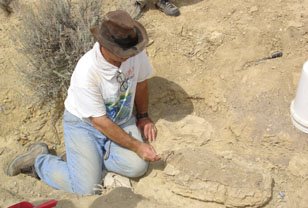
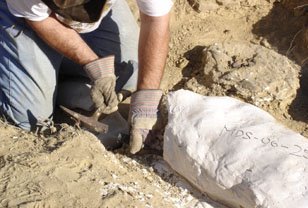
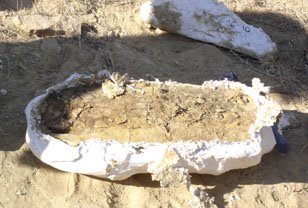
So, each bone need to have all of it’s pieces immobilized, or held together in place, just as the bones of your broken leg would need to be. First we expose the bone, impregnate it with an archival consolidant (glue), trench around it so it stands on a pedestal of matrix, cover with a separating agent so that the Plaster of Paris used will not stick to the actual bone (we use wet toilet paper – TP is good for many things around camp!), and apply burlap strips soaked in plaster (people fight for a chance to cut up the strips beneath our only shade tree – a rather sad-looking Pinyon Pine). Once dry, we chisel around the plastered block and attempt to overturn it without bits of bone falling out the bottom. We usually succeed at this. The bottom is then capped with TP and plaster and the block readied for shipment home. Of course, field numbers are given the blocks so that they can be matched up with the contextual data that we have recorded for each fossil. Photos of this process are available on this blog., I believe (after my adventure on Monday).
Mike Papp, an environmental geologist in Cincinnati with a master’s in vertebrate paleontology has arrived to join the crew. Mike is a great and dedicated worker and lab volunteer who has been coming to Mother’s Day every year since we started work here in 1999. He also has a very fine sense of humor. Fortunately he and the rest of the gang have not made use of the food coloring at the site this year. No plaster blocks of bone made out to look like giant Easter eggs as in the past. Somehow, this offends my sensibilities as a traditionalist in the field. Never mind, they enjoyed their green eggs and spam – even Sam (-You-Are!).
On the wildlife front, the turkeys are back at YBRA. Down at MDS, plenty of mule deer and rabbits (cotton-tail and jack), and among birds, some prairie chicken, doves, magpies, jays (of some sort), hawks, and a pelican. Yes, a pelican! They do wander about inland and while the Clark’s Fork is nearby, this one seems to have strayed ever so slightly.
As for me I’m going to stray off to bed. I have to write this darn thing late at night after the other work is done. My big accomplishment today was to make my annual visit to the BLM (Bureau of Land Management) state offices in Billings to say hi (and inquire about a crane or tractor for lifting my “Dodson” dinosaur – they’ll get back to me), buy 300 lbs. more plaster at the Home Depot, and comparison shop for a dual axle trailer. This might be the best option for hauling back the remaining 14 articulated dorsal vertebrae of the “DD.” We’ll try to estimate it’s final weight first. Although, a trailer would not normally be available, I have an anonymous donor who wants to sponsor the big dinosaur project to get this beast back to Cinti (Thanks! - If he’s reading this blog and has a view to the contrary – he should speak up now or forever hold his piece, etc.).
Bye.
Wednesday, August 02, 2006
Field School Field Trip Photos
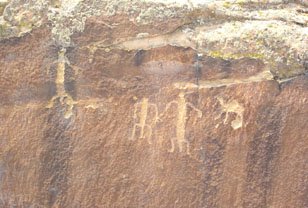
Native Americans carved these stone figures approximately 800 years ago, now to be seen in Petroglyph Canyon on the Montana-Wyoming border.
A variety of animal figures perhaps provided hopes for a bountiful hunt.
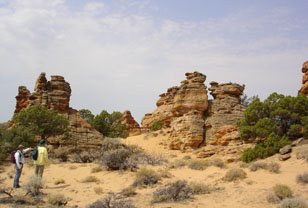
Spectacularly colorful Paleozoic and Mesozoic sedimentary rocks are exposed in the dissected Crooked Creek Anticline at the southwestern end of the Pryor Mountains.
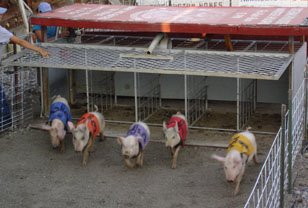
Pigs jump from the starting gate as Montana’s favorite races get underway at the Bearcreek Saloon and bring our first week of digging to a close. Another batch of photos ...
Four articulated dorsal vertebral centra are exposed along thebottom edge of the main block of our “Dodson Diplodocus” at Rattlesnake Ridge. Another ten vertebrae in the series are covered with a preliminary plaster field jacket.
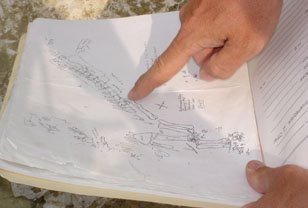
Glenn points out the mapped positions of “Dodson Diplodocus” skeletal elements as originally discovered.
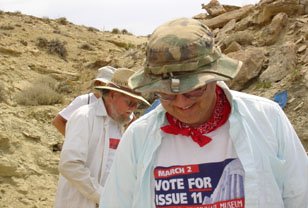
Glenn is a walking billboard for Cincinnati Museum Center while in the field!
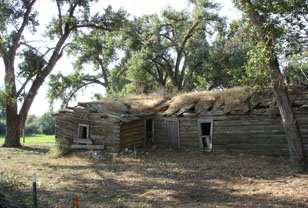
One of the early homesteader cabins in the region remind us that those who tamed the western country lived not so may generations ago.
Glenn discusses ancient river channel cross-bedded sandstones with Museum Center board member Buck Niehoff. Tuesday, August 01, 2006
August 1, 2006
Aside from my computer issues, success came with an adventure of its own. My off day (from the field, not from work) between participant groups left me with a chance to catch up on paperwork and this blog. My latest idea was to go into town (Red Lodge) and find a high-speed connection. The first problem was that the library was closed on this day, Monday, but I’d been told that the coffee shop has a connection. The second problem was that in exchanging groups, while still getting digging done at both Mother’s Day and “Dodson,” I had been left without a vehicle. Red Lodge is several miles and 2,000 feet of elevation away (I may take up jogging when I get back, but not just yet, thanks) so walking did not seem like a good idea.
I was offered one of the YBRA geology vans (minus students on their field course) if I dropped it in town for new tires. Fine. I’d catch up on a few things and then drive on in. When I turned around, the van was gone (off to the airport, I learned – only to have a flat along the way!). OK. Last resort – the old camp truck. Earlier on this blog I was boasting of the Museum’s new Toyota Tundra. Now, I find myself in a 1970 (or thereabouts) Ford 150 Custom. Try that on the camp road for a bone rattling experience. It’s 3 on the floor with overdrive and a new clutch if you can reach it! I only remembered that it has a tendency to shake itself out of gear while fish-tailing on the way up the long, steep, very rough, dirt road hill, after I nearly rolled back down it. Nevermind. The pictures are up and nothing succeeds like success.
What else?…. Oh, yes, the fire. No sign of it now thankfully. I think it’s still a problem for Livingstone but is unlikely to jump to our area just now. And the weather has broken! Just 60 to 70 degrees today – what a relief (although the new winds bring the dust everywhere and threaten to blow down Mason’s less than quality tent)!
Bob, Brian, Mark and Lily, our new field schoolers, are enthusiastic dinosaur diggers and we got right to work today after the requisite geology tour. Brian has said repeatedly that he feels like it’s Christmas – the excitement of unearthing something not seen for 140 million years makes us all feel like kids. A variety of new bones are evident and we will soon get to removing them. I’ll try to tell you how that’s done soon.
Cheers for now!
Photos of dinosaur finds!
Work during the first week of Cincinnati Museum Center’s Dinosaur Field School has exposed a caudal (tail) vertebra and a lower limb bone (epipodial).
Dinosaur Field School participant Joe Gray uncovers a series of four articulated caudal (tail) vertebrae.
Mason and Joe apply plaster soaked burlaps strips to the block of caudal vertebrae. Note Joe’s wristwatch about to become a fossil!
Joe begins to loosen the capped block from it’s home of 140 million years.
Hands gather around, preparing to turn the block over in one quick motion.
The underside of the block shows no exposed bones – a perfect flip!
The block containing the fossil vertebrae is ready to go!